Cute Dog and Cat Dingbats Font
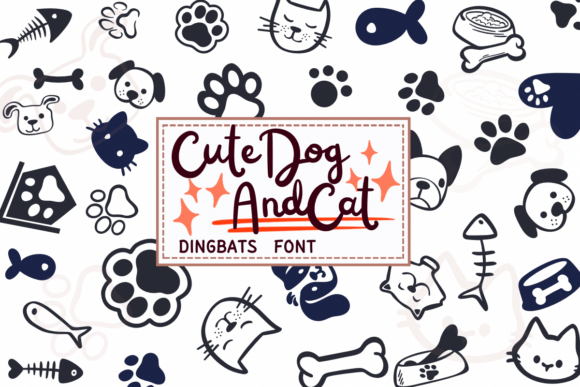
If you’ve ever spent 20 minutes hunting for the perfect paw print icon—only to find it’s low-res, overused, or buried in a bloated icon pack—you’ll appreciate what Cute Dog and Cat delivers: a focused, hand-drawn dingbats font built entirely for pet lovers and professionals who work with them. It’s not another generic symbol set. It’s a purpose-built toolkit—where every character is a vector illustration of something warm, familiar, and authentically pet-related.
What Makes This Font Different From Standard Icons?
Most dingbats fonts scatter symbols across themes—arrows, stars, weather, tech—and force you to sift through irrelevant glyphs. Cute Dog and Cat eliminates that noise. Every single glyph is vetted, hand-crafted, and pet-specific: sleeping cats, perky terriers, fish bones, yarn balls, collar tags, squeaky toys, and even tiny dog-poo silhouettes (yes, they’re tastefully stylized). No filler. No licensing surprises. Just clean, scalable vectors you type like text.
Because it’s a true OpenType font, it works natively in Adobe Illustrator, Photoshop, InDesign, Figma, Affinity apps, and even Microsoft Word or Google Docs (with some setup). You don’t need to copy-paste SVGs or wrestle with layers. Press “P” and get a paw print. Type “B” and drop a bone. That immediacy saves time—and mental bandwidth—especially when iterating on layouts or building asset libraries.
Real-World Uses You Can Start Today
This isn’t just for designers. Cute Dog and Cat fits naturally into workflows across disciplines:
- Pet business owners use it to build cohesive branding—think custom water bowl labels, storefront decals, or loyalty card stamps—all drawn from the same visual language.
- Educators and veterinarians embed friendly icons directly into handouts, vaccination charts, or behavior guides. A cat face next to “litter box training” or a bone beside “chew toy safety” improves comprehension without adding text.
- Bloggers and social media managers drop glyphs into Canva or CapCut titles, story highlights, or email headers—adding charm without slowing down content production.
- Textile and stationery designers layer glyphs into seamless patterns for bandanas, tote bags, or greeting cards. Since all icons are vector-based and uniformly spaced, scaling and tiling stay crisp at any size.
- Teachers and homeschoolers create visual schedules or reward charts where a dog icon marks “walk time” and a fish skeleton signals “feeding duty”—making routines tangible for kids and neurodiverse learners.
Why Vector Dingbats Beat Clip Art—Every Time
You might wonder: why not just grab free clip art? Because consistency matters. Clip art collections rarely share line weight, scale, or stylistic rhythm. One paw looks chunky; another looks sketchy; a third has inconsistent stroke endings. That visual dissonance weakens brand trust—even subtly.
Cute Dog and Cat solves that by offering uniform stroke thickness, balanced negative space, and harmonious proportions across all 200+ glyphs. Whether you’re using a tiny 8-pt icon in a brochure footnote or blowing up a cat face to 300 pt for a mural, the integrity holds. And since it’s vector—not raster—you never hit pixelation walls.
Smart Implementation Tips
Before diving in, consider these practical notes:
- Check software compatibility first. While most modern design tools support OpenType dingbats, older versions of PowerPoint or Pages may require converting glyphs to outlines—or using a fallback workflow.
- Use ligatures intentionally. Some combinations (like “dog” + “bowl”) trigger contextual alternates. Explore the character map or glyph panel to discover hidden pairings—it’s how you unlock subtle storytelling (e.g., a cat peeking behind a yarn ball).
- Pair wisely with type. This font shines alongside clean, friendly sans-serifs (like Montserrat or Nunito) or gentle serifs (like Merriweather). Avoid clashing scripts or overly decorative fonts—they compete for attention instead of complementing the icons.
- Respect context. A playful bone icon works beautifully on a pet bakery menu—but could misfire in clinical veterinary documentation. Match tone to audience: warmth for retail, clarity for education, precision for medical settings.
Where This Fits in Your Creative Ecosystem
Think of Cute Dog and Cat as a utility—not a gimmick. It doesn’t replace illustration skills, but it removes friction between idea and execution. Need a quick mockup for a client pitch? Drop three glyphs and go. Building a Shopify banner? Swap stock photos for custom, ownable icons in under a minute. Teaching a workshop on pet nutrition? Turn bullet points into visual cues that stick.
It also scales ethically. Unlike stock assets tied to subscriptions or usage caps, this font is a one-time, perpetual license. Once installed, it lives in your system—no logins, no expirations, no surprise fees when you launch your second product line.
A Note on Authenticity and Audience Connection
Pet owners respond to sincerity—not saccharine overload. The hand-drawn quality of Cute Dog and Cat avoids the sterility of AI-generated icons while sidestepping cartoonish clichés. There’s gentle asymmetry in the cat ears. Slight variation in paw print angles. A quiet sense of movement in the tail glyphs. That nuance builds emotional resonance—because real pets aren’t perfectly symmetrical, and neither should their visuals be.
That authenticity translates directly to engagement. Customers notice when branding feels considered, not templated. When a rescue group uses these icons on adoption flyers, the warmth feels earned—not outsourced. When a pet food startup uses the fish skeleton glyph beside “wild-caught salmon,” it communicates specificity and care—not just cuteness.
Final Thought: Tools Should Serve Intent, Not Steal Time
Great creative tools don’t shout. They streamline. They reduce decision fatigue. They let you focus on the message—not the mechanics of delivering it. Cute Dog and Cat does exactly that: it gives you a reliable, joyful vocabulary for talking about pets—without requiring illustration expertise, licensing negotiations, or hours of asset management. Whether you’re launching a mobile app for dog walkers or stitching a custom cat-themed quilt, it meets you where you are—with zero pretense and full practicality.